Compound Gates: XOR and the Half Adder
You've built AND, OR, and NOT from transistors. Now you'll build gates out of those gates — and then wire them into something that actually does arithmetic: a circuit that adds.
Overview
You'll build your first compound gate, the XOR gate, from parts you've already made, then use it to build a half adder — a circuit that adds two bits.
Before you start
Open Antares with your MyNOT, MyAND, and MyOR gates available.
You've got it when…
-
MyXORoutputs1only when exactly one input is1. - Your half adder produces the correct
SUMandCARRYfor every input. - You've completed the XOR and half-adder truth tables.
Collaboration & AI
Work: On your own. Compare results with a neighbor to check, but wire your own circuits.
AI — AIAS Level 1, No AI: Reason through how the gates combine yourself. What the levels mean.
A Compound Gate: XOR
A compound gate is a logic gate built from gates you've already made. The XOR ("eXclusive OR") gate works like an OR gate, with one difference:
- OR gate: output is
1if A is1, B is1, or both are1. - XOR gate: output is
1only if exactly one input is1— not both.
First, complete the truth table for XOR based on that description.
MyXOR
| A | B | O |
|---|---|---|
Now build it in Antares.
- Create a new circuit named
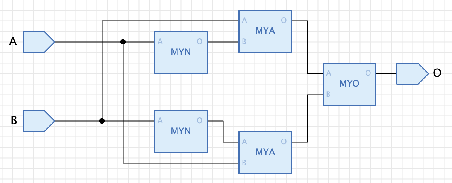
MyXOR. - Add these components:
- Two of your
MyNOTgates. - Two of your
MyANDgates. - One of your
MyORgates. - Two Circuit Inputs from the Input folder.
- One Circuit Output from the Output folder.
- Two of your
- Rename the two Circuit Inputs A and B.
- Arrange and connect the components as shown below.
- Test it in simulation mode. Does it match your truth table?
The Half Adder
A half adder adds two single binary digits (bits).
- Inputs: two bits, A and B.
- Outputs:
- Sum — the result of adding the bits (like regular addition without carrying).
- Carry —
1if both inputs are1(the sum "carries" to the next column).
It's called a half adder because it can't accept a carry in from a previous
addition — only the two bits you give it. Remember binary addition: add A + B for
the SUM column, and if the result needs to carry, put a 1 in the CARRY
column.
Half Adder
| A | B | SUM | CARRY |
|---|---|---|---|
To build the half adder:
- Create a new circuit named
HA. - Add these components:
- One
MyXORgate. - Two Circuit Inputs from the Input folder.
- One Circuit Output from the Output folder.
- One
- Rename the two Circuit Inputs A and B.
- Rename the Circuit Output SUM.
- Arrange and connect the components as shown below.
- Test it in simulation mode. Does it match the SUM column?
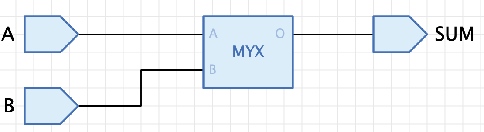
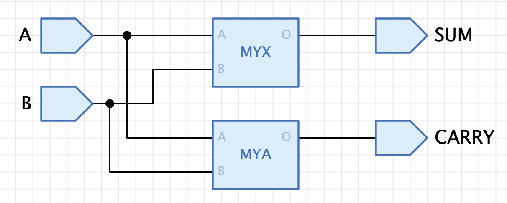
If it's wired correctly, SUM is the correct result of A + B. Now we need to
carry a bit out when A and B are both 1 (because binary 1 + 1 = 10 — "zero,
carry the one"). Add a few more components:
- Add these components:
- One
MyANDgate. - One Circuit Output from the Output folder.
- One
- Rename the added Circuit Output CARRY.
- Arrange and connect the components as shown below.
- Test it. Does it match both the SUM and CARRY columns?
Turn It In
- Your completed XOR and half-adder truth tables (in your notebook).
- A screenshot of each new circuit,
MyXORandHA.
How It's Graded
This lab is worth up to 4 points. One score covers everything you turn in.
| Score | What it looks like |
|---|---|
| 4 — Excellent | MyXOR and HA are both built from your own gates and verified in simulation against complete, correct truth tables — SUM and CARRY right for all four input combinations. |
| 3 — Above Average | Both circuits work, with a minor slip — one wrong truth-table row, or a table filled in after testing rather than predicted first. |
| 2 — Average | MyXOR works but the half adder doesn't (or is missing its CARRY half), or the circuits work but a truth table is missing or substantially wrong. |
| 1 — Below Average | Neither circuit matches its truth table, or screenshots and tables are largely missing. |
| 0 — Failing | Nothing turned in, or no evidence of either circuit. |